Embedded /
Solar
Youtube
155 The 5 Best Solar ChargerBoards for Arduino and ESP8266 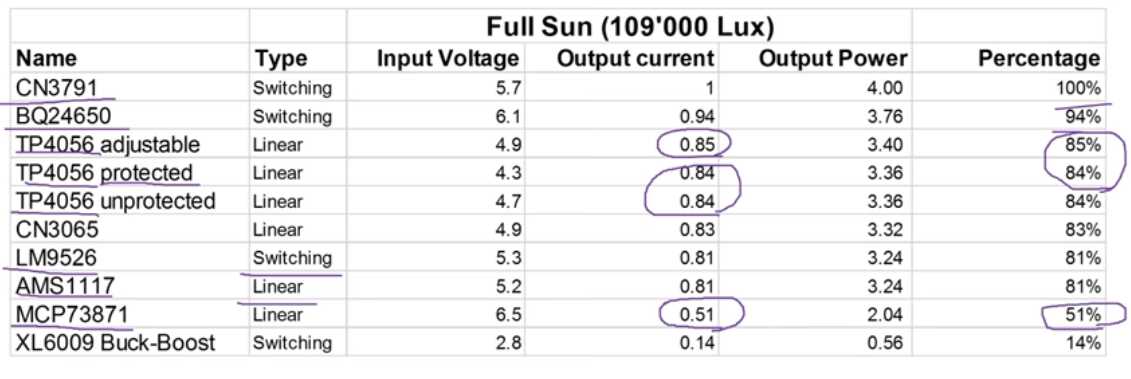
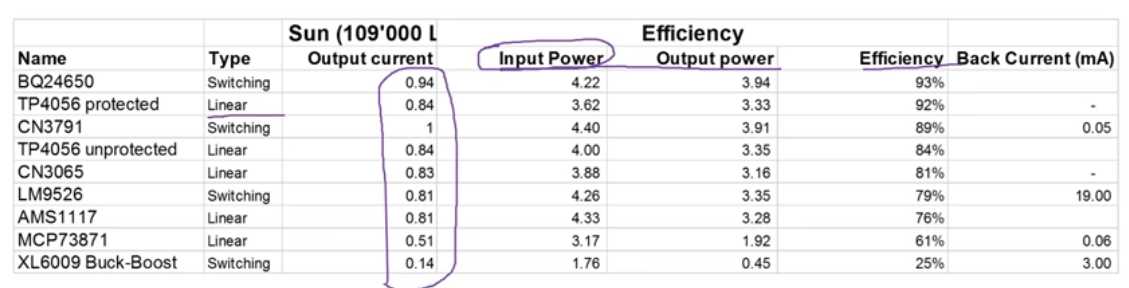
* solar_chagers_compare3.jpg Δ
- YOUTUBE - #47 Power Saving with ESP8266 (Sleep Mode) Tutorial with some Tricks
- YOUTUBE - #142 Solar Power for the ESP8266, Arduino, etc.
- YOUTUBE - #155 The 5 Best Solar ChargerBoards for Arduino and ESP8266
- YOUTUBE - #160 40 Cent Do-It-Yourself Li-Ion Protection for 18650 Cells (Tutorial) and how they work
- YOUTUBE - #351 10 Battery Power Boards for Raspberries and ESPs. Start of “SuperPower” project
- YOUTUBE - #383 Cheap and simple Solar Power for our small Projects (ESP32, ESP8266, Arduino)
- G6EJD - Tech Note 130 - Solar Power for Projects (Arduino/ESP8266/ESP32)
- G6EJD - Tech Note 131 - ESP32/8266 Reducing Battery Load Hints & Tips
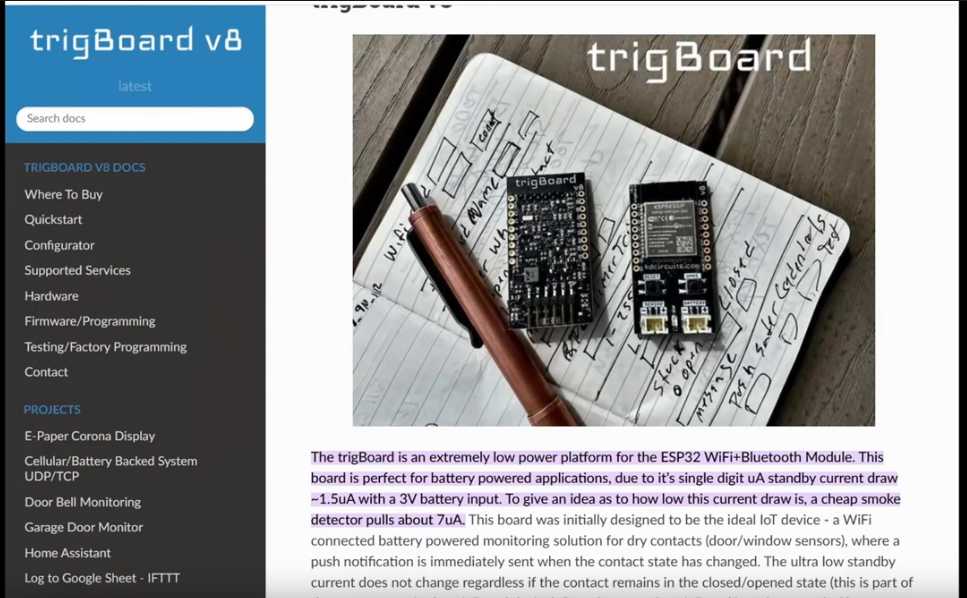
trigBoard & MicroWakeUpper
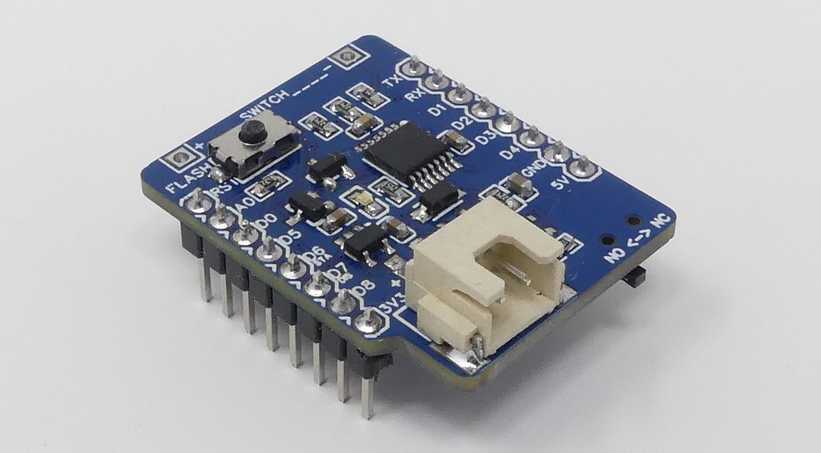
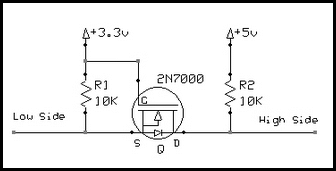
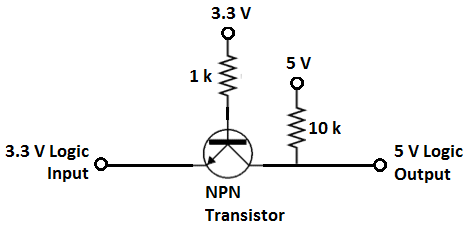
Level converters
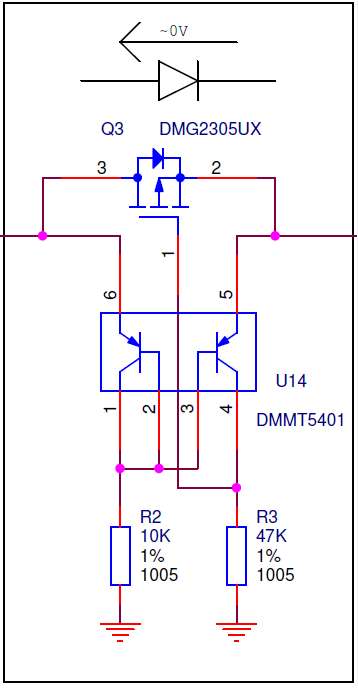
Ideal diode
DC-DC converters
- GUIDE : https://www.elektrolab.eu/blog/spinane-dc-dc-menice-pro-pouziti-v-elektronice
- COMPARISON : https://drive.google.com/file/d/1Cy-G3mUZ7UwE7yyxL4LdC78jGLikQfsw/view
Wemos mini battery shield 1A
Is LiPo 4.2V charger and 5V boost converter for Wemos D1 mini.
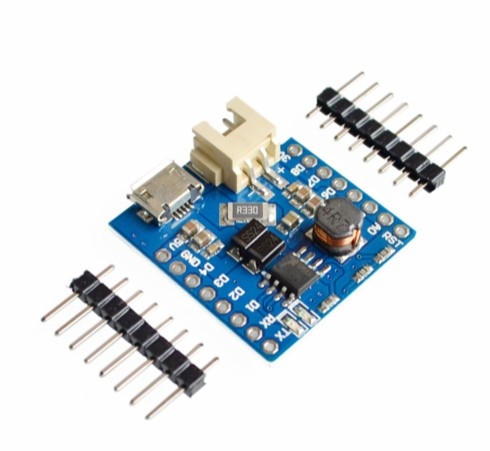
- https://techfun.sk/produkt/wemos-mini-battery-shield-1a/
- https://www.wemos.cc/en/latest/d1_mini_shield/battery.html
- 2$ LiPo Charger & Boost Converter? TP5410 Test
- no discharge battery protection
- no short circuit protection, just current limitation
- charging current lower than declared!!!
TP4056 - simple
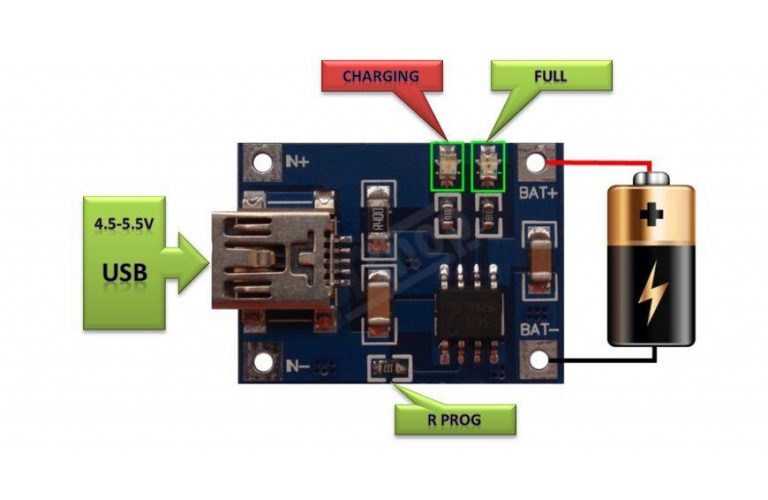
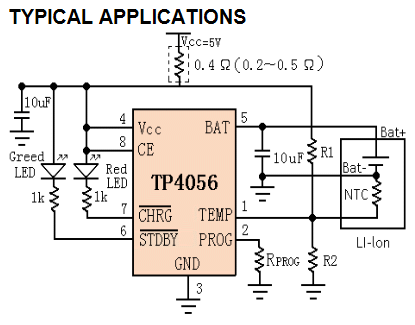
- https://techfun.sk/produkt/nabijaci-modul-pre-litiove-baterie-tp4056/
- DataSheet ENG : https://dlnmh9ip6v2uc.cloudfront.net/datasheets/Prototyping/TP4056.pdf
- RED LED = Charging
- BLUE LED = Fully chrged
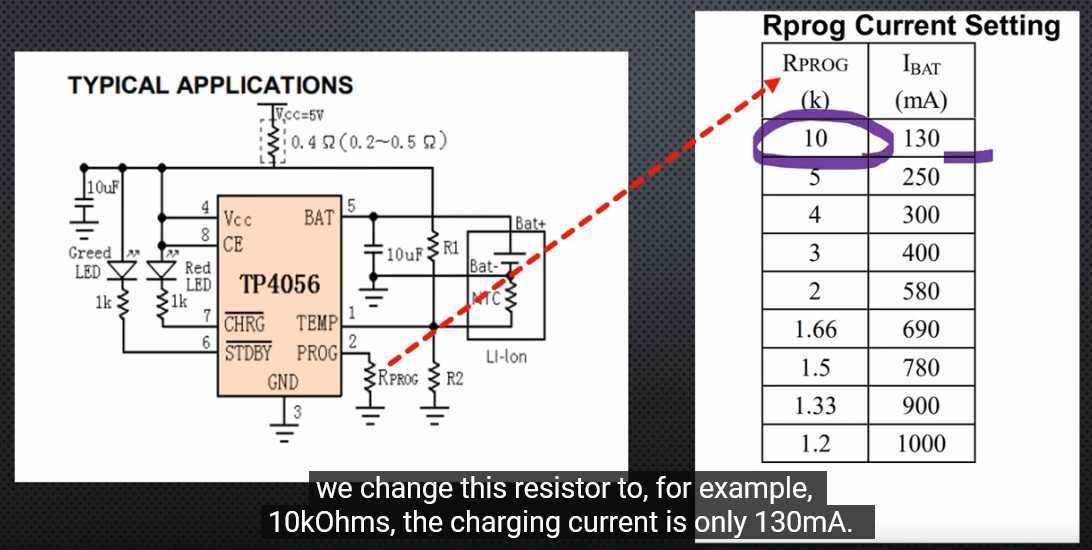
- PROG(Pin 2) :
Constant Charge Current Setting and Charge Current Monitor Pin charge current is set by connecting a resistor RISET from this pin to GND. When in precharge mode, the ISET pin’s voltage is regulated to 0.2V. When in constant charge current mode, the ISET pin’s voltage is regulated to 2V.
In all modes during charging, the voltage on ISET pin can be used to measure the charge current as follows :Ibat = Vprog / Rprog * 1200 (Vprog=1V)
TP4056 - with protection
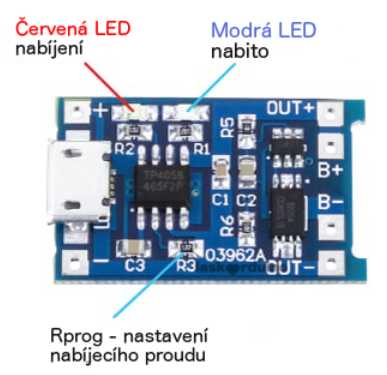
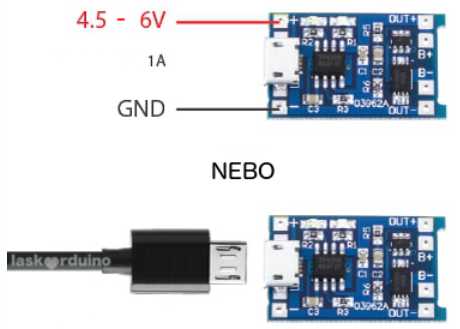
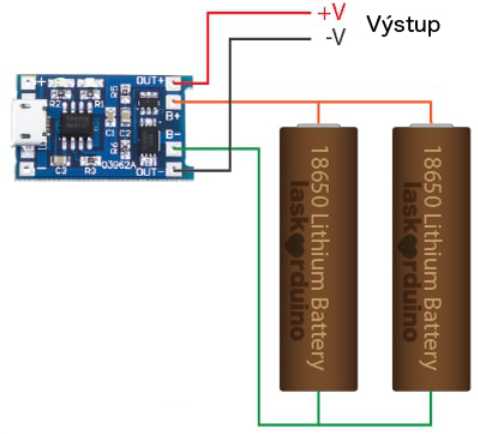
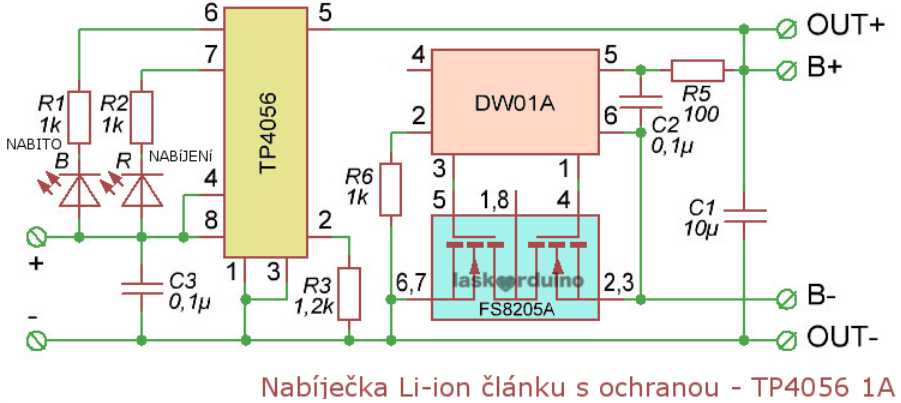
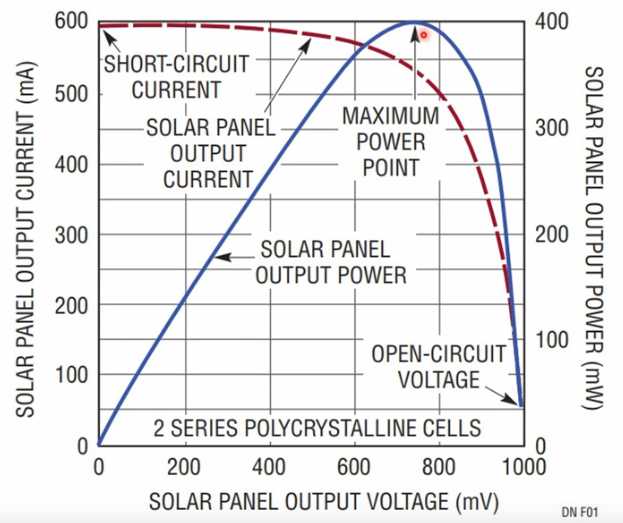
- https://www.laskarduino.cz/nabijecka-li-ion-clanku-tp4056-s-ochranou-microusb/
- https://www.best-microcontroller-projects.com/tp4056.html
- DataSheet ENG : https://dlnmh9ip6v2uc.cloudfront.net/datasheets/Prototyping/TP4056.pdf
- YOUTUBE - #383 Cheap and simple Solar Power for our small Projects (ESP32, ESP8266, Arduino)
- RED LED = Charging
- BLUE LED = Fully chrged
- Input voltage: 4.5V – 5.5V
- Output current: 1A (@ Rprog = 1200 Ohm)
- https://www.best-microcontroller-projects.com/tp4056.html
- https://www.best-microcontroller-projects.com/tp4056-page2.html
- Warning :
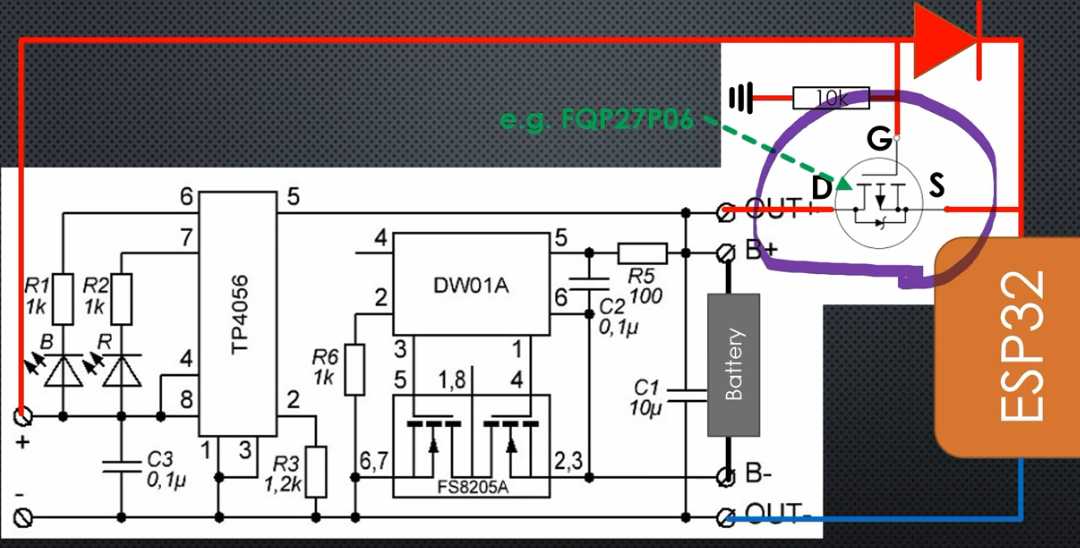
There are a lot of circuits out there that show the use of the TP4056 as both a charger and a load driver - Not Good.
If a load is attached to the battery while charging, then the TP4056 may not detect when the charge current has fallen to C/10.
So it could continue charging - this could be dangerous.
You should never use the TP4056 as a charger and as a load driver at the same time.
When charging the battery, switch off the load, and when loading the battery, switch off the charger.
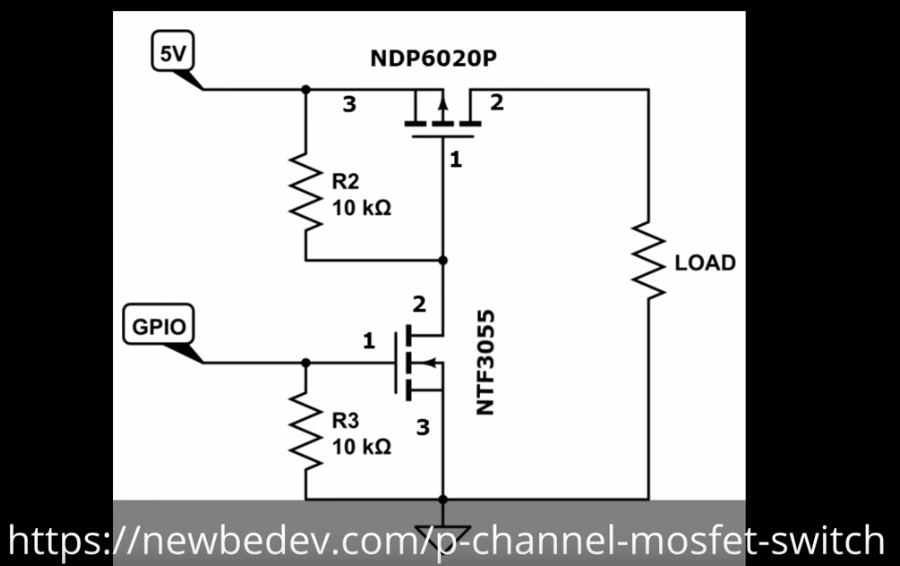
Alternatively use a PMOSFET, a resistor and a Schottky diode (See page 2 on how to do this). - Note :
You need to change the current programming resistor on the breakout board to match the lithium battery you are using
- the default is 1.2k which is for a 1Ah (1000mAh) battery
- Warning :
Solar Power Load Sharing
- https://github.com/gbhug5a/Solar-Power-Load-Sharing
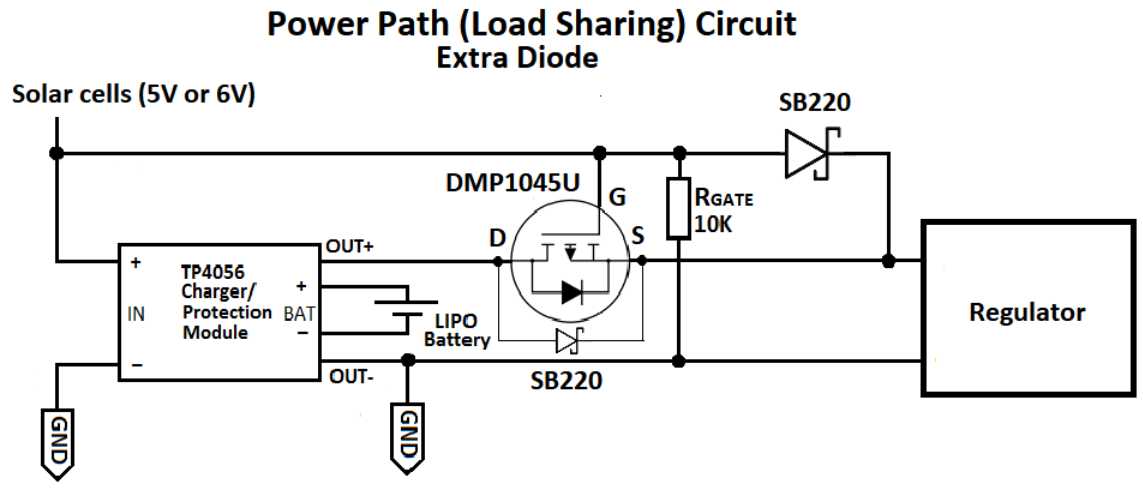
- Added Diode
If avoiding the night time Vf drop is felt to be important, one should at least make the two diode operation at all other times as efficient as possible.
That can be done by installing another Schottky diode (D2 below) across the mosfet in parallel with the body diode.
That effectively replaces the body diode with one which has a much lower Vf, so the output voltage
under partial illumination would be almost 1/2 volt higher. Shown below are the schematic and simulation of this version.
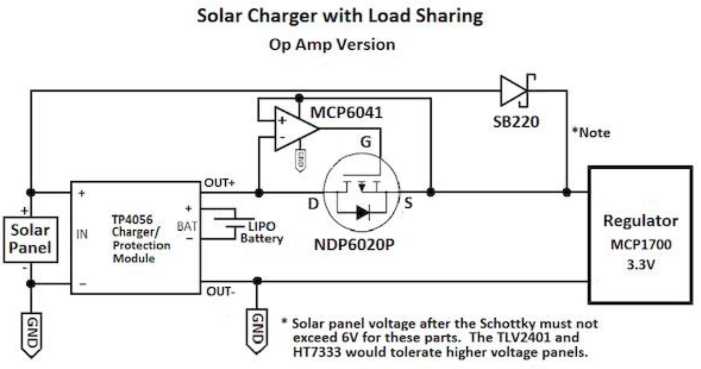
The only difference is the lower voltage drop under partial illumination - OpAmp Version
The diode voltage drop can be eliminated entirely if an opamp is used to control the mosfet gate.
The opamp non-inverting input is connected to the circuit output, which is also the mosfet source terminal,
and the inverting input is connected to the battery, which is also the mosfet drain terminal.
If output voltage is lower than battery voltage, the opamp drives the gate to ground,
which turns on the mosfet. Otherwise the opamp drives the gate high, which turns the mosfet off.
Here are the schematic and simulation for this version. The simulation shows that the output voltage never falls below battery voltage, which maximizes battery life
The opamp shown in the simulation is the LT1494. It has ultra-low supply current - about 1uA - and the common mode range of its inputs extends to just above the upper rail.
That means there's no need for resistor dividers or biasing of any kind that would draw current.
The LT1494 is quite expensive at about $5.00, but all physical testing of this circuit was done with the MCP6041, at $0.66, which has the same characteristics.
However, the MCP6041's maximum permitted power supply voltage is 6V, which only works for 5V solar panels.
The TLV2401 has a 10V limit, and should work well with 5.5V and 6V panels. It costs about $2.60.
The LT1494 was used in the simulation only because Spice models that work in LTspice aren't available for the two primary choices,
both of which come in DIP packages and in the usual SMD packages.
Rail-to-rail - best OpAmp replacements (GME.sk)
    TS912ID        €1,26  Vcc=2,7..16V;   Voffs=2mV;     Icc=2 x 200uA;  - 1,4MHz, channels:2, SMD
    TS922IDT       €1,10  Vcc=2,7..12V;   Voffs=0.9mV;   Icc=3mA tot;    - 4MHz, channels:2, SMD, BiCMOS
    MAX4208AU      €2,84  Vcc=2,8..5,5V;  Voffs=0.02mV;  Icc=750uA;      - 750kHz, channels: 1, SMD, (Icc=1.4uA in shutdown mode)
    OP295GSZ       €5,71  Vcc=3..36V;     Voffs=0.3mV;   Icc=2 x 150uA;  - 85kHz, channels:2, SMD
    AD8626ARMZ    €10,55  Vcc=5.0..24V;   Voffs=0.5mV;   Icc=2 x 710uA   - 5MHz, channels:2, SMD
Solárna nabíjačka s funkciou MPPT 5A DC-DC step-down
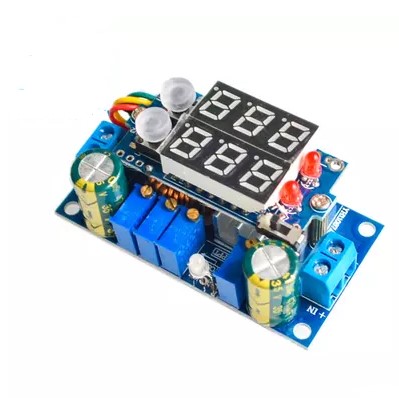
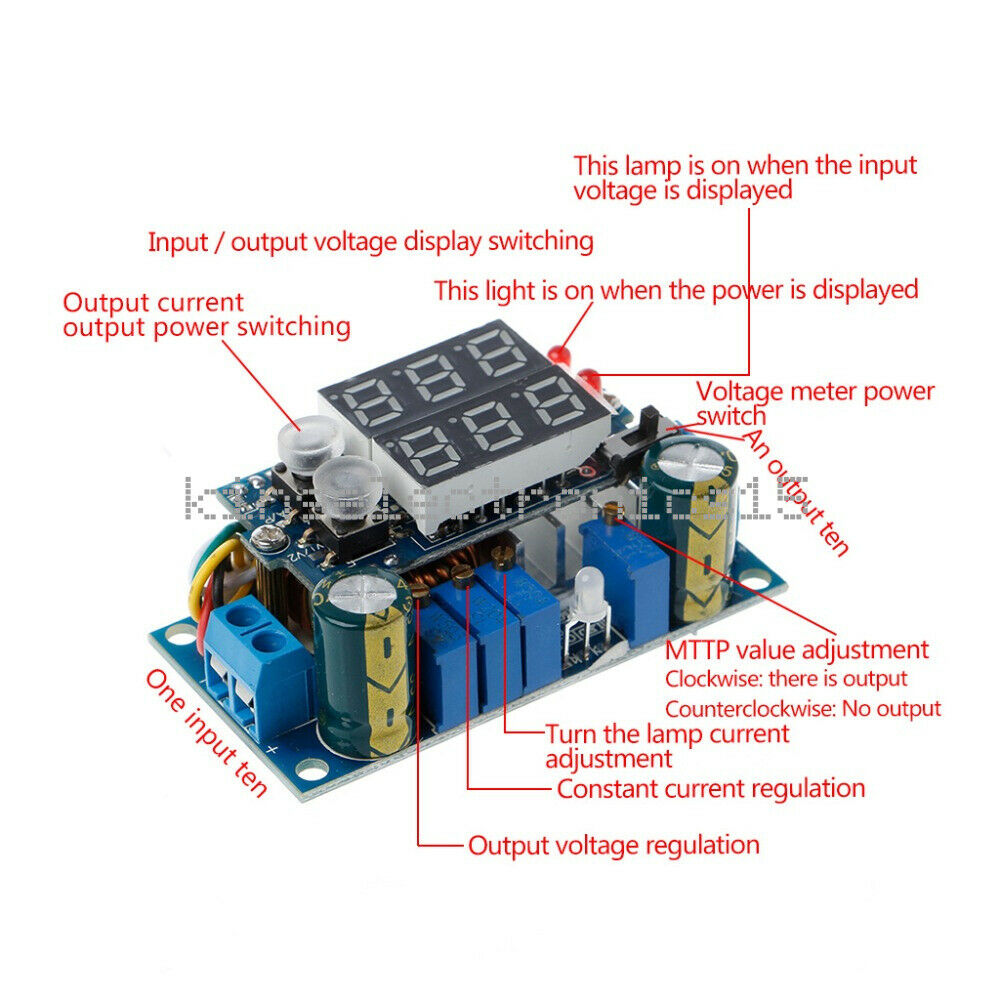
- https://techfun.sk/produkt/solarna-nabijacka-s-funkciou-mppt-5a-dc-dc-step-down/
- YOUTUBE - Julian's Postbag: #48 - MPPT Solar Buck Regulator LED Display
- https://www.ebay.com/itm/162863925905 / https://www.ebay.com/itm/223801483062
- Input voltage: 6-36V
- Output voltage: 1.25-32V continuously adjustable (step down)
- Multifunction double display: input voltage, output voltage, output current, output power
- Charging indicator: charging red, bright green when fully charged. Turn lamp is the output current detection.
Buck-Boost - XL6009 - buck/boost adjustable
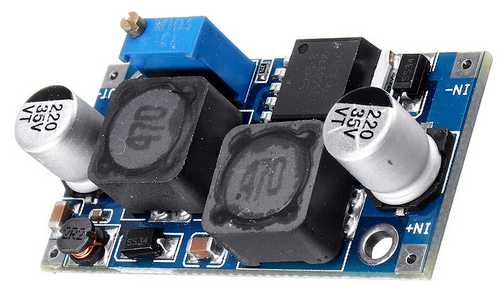
- https://techfun.sk/produkt/xl6009-buckboost-menic-napatia/
- https://www.banggood.com/sk/2Pcs-DC-DC-Boost-Buck-Adjustable-Step-Up-Step-Down-Automatic-Converter-XL6009-Module-Suitable-For-Solar-Panel-p-1372422.html
- Vstupný rozsah: 3.8 V – 32 V
- Výstupný rozsah: 1.25V – 35 V
- Výstupný prúd: 3 A
Buck-Boost - S9V11F5 - Buck/boost 5V converter
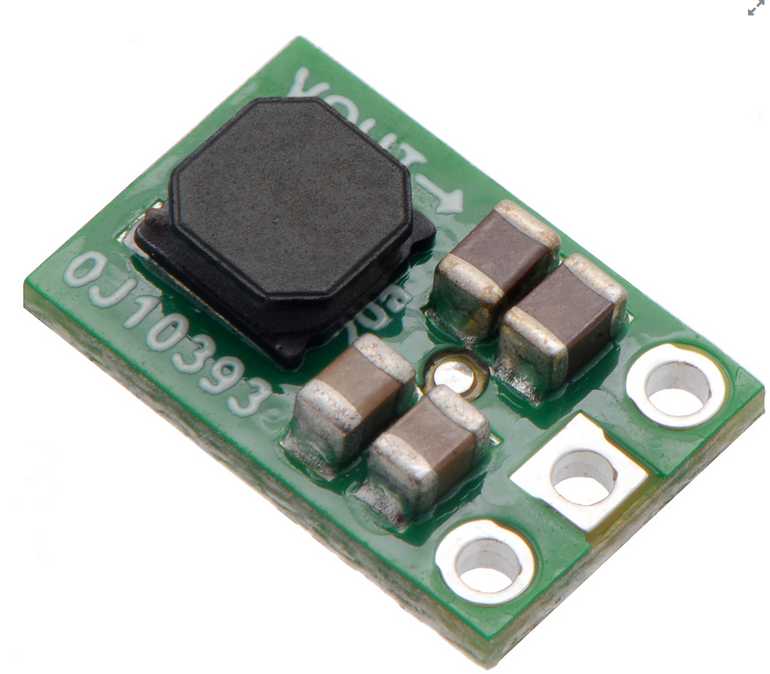
Buck-Boost - S09 - BuckBoost - 3.3V / 4.2V / 5.0V
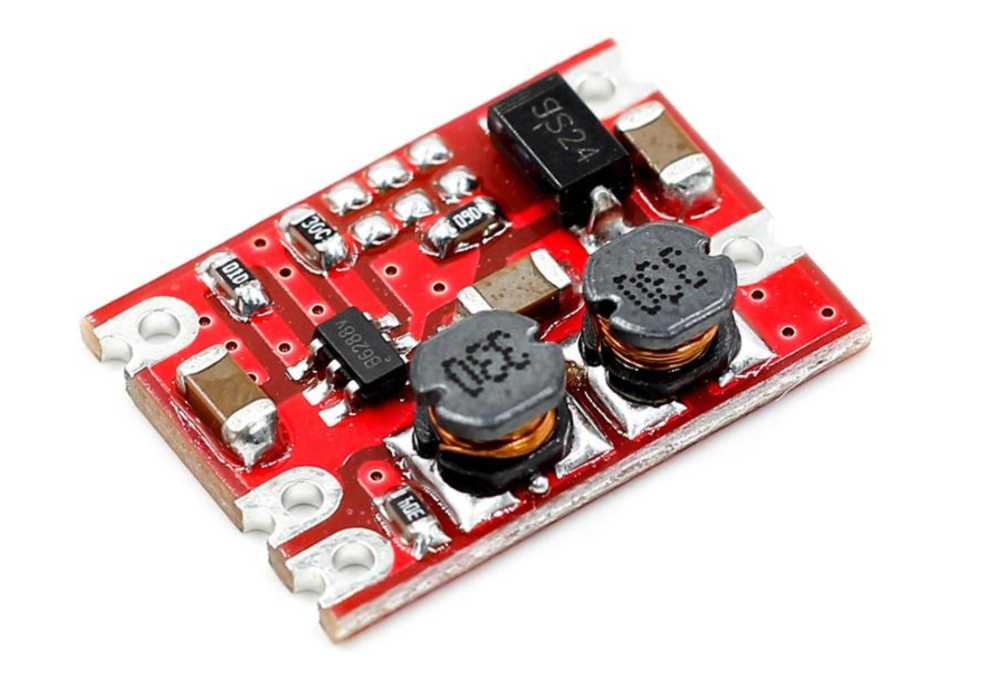
- https://techfun.sk/produkt/buck-boost-obojsmerny-stabilizator-napatia-rozne-varianty/
- https://www.aliexpress.com/item/32909002977.html
- Input voltage : 3v-15v
- Output voltage : 3.3V/4.2V/5V/9V/12V
- Output current : 0.6A
- Conversion efficiency : 80%
- Output ripple : <50mV
- Output accuracy : +-0.1V
- Strangely the enable pin requires more then 3.4 volts?
Pozor :
- ak chcete ovaldat converter cez EN pin, tak napatie pinov procesora (3.3V) na to nestaci
- tj. ak je converter napajany napriklad priamo z LiPo baterie (Vin=4.2V), tak EN=3.3V nestaci na zapnutie convertera
StepDown - ZK-SJ4
POZOR OJEB : je to len STEP-DOWN
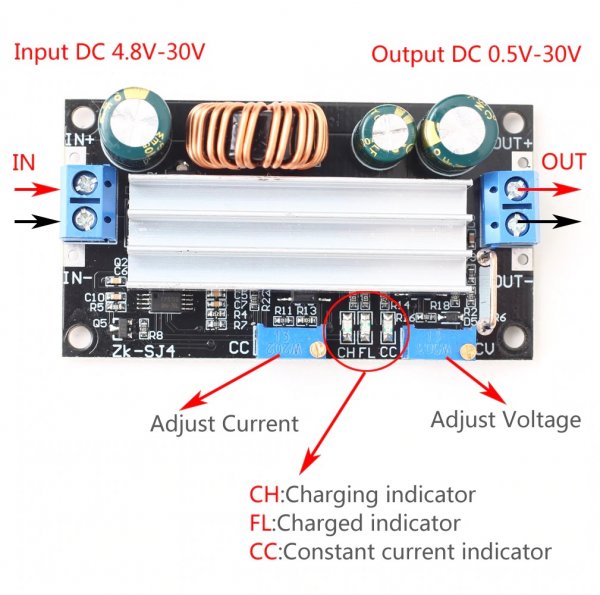
- https://techfun.sk/produkt/solarna-nabijacka-zk-sj4-buck-boost/
- http://www.icstation.com/solar-charging-module-adjustable-step-step-down-power-supply-module-boost-buck-voltage-regulator-p-13410.html
- 4.Potentiometer/LED introduction:
- 1>.CV Potentiometer: Adjust output voltage. Increase the output voltage when rotating clockwise.
- If charge a 3.7V (1S) lithium battery, adjust the output voltage to 4.2V
- If charge a 3.7V (2S) lithium battery, adjust the output voltage to 8.4V
- If charge a 3.7V (3S) lithium battery, adjust the output voltage to 12.6V - 2>.CC Potentiometer:Adjust output current. Increase the output current when rotating clockwise.
- 3>.CC LED:Red LED. Constant current output indicator. It enters the constant current state when the load current reaches the set current and CC constant current indicator turns ON.
- 4>.FL LED:Green LED. Charged fully indicator.When battery is charged fully .It will turn ON. It will turn ON if output current is less than 0.2A when the Set Current is 2A(about 10%).
- 5>.CH LED: Blue LED. Charging indicator.It will turn ON when charging.
StepDown - LM2596 step-down menič DC-DC
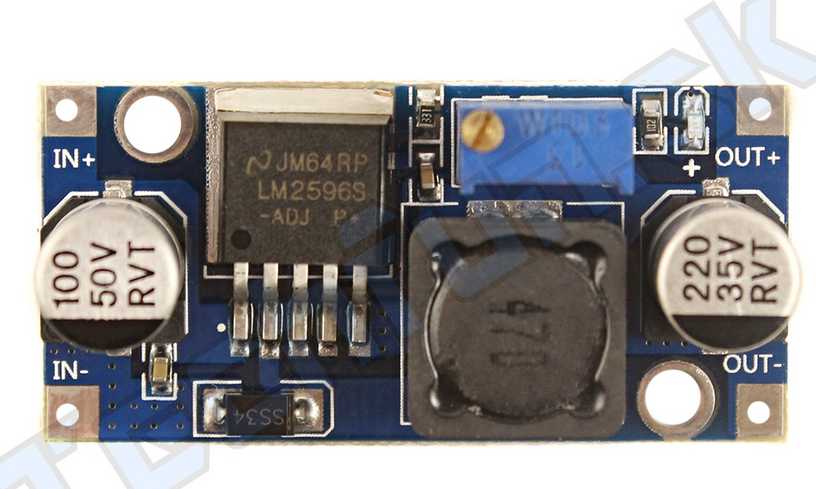
- https://techfun.sk/produkt/lm2596-step-down-menic-dc-dc/
- Vstupné napätie: 3.2V ~ 40V
- Výstupné napätie: 1.25V ~ 35V
- Výstupný prúd: 3A (max)
BMS Lion 3S/4S/5S 100A
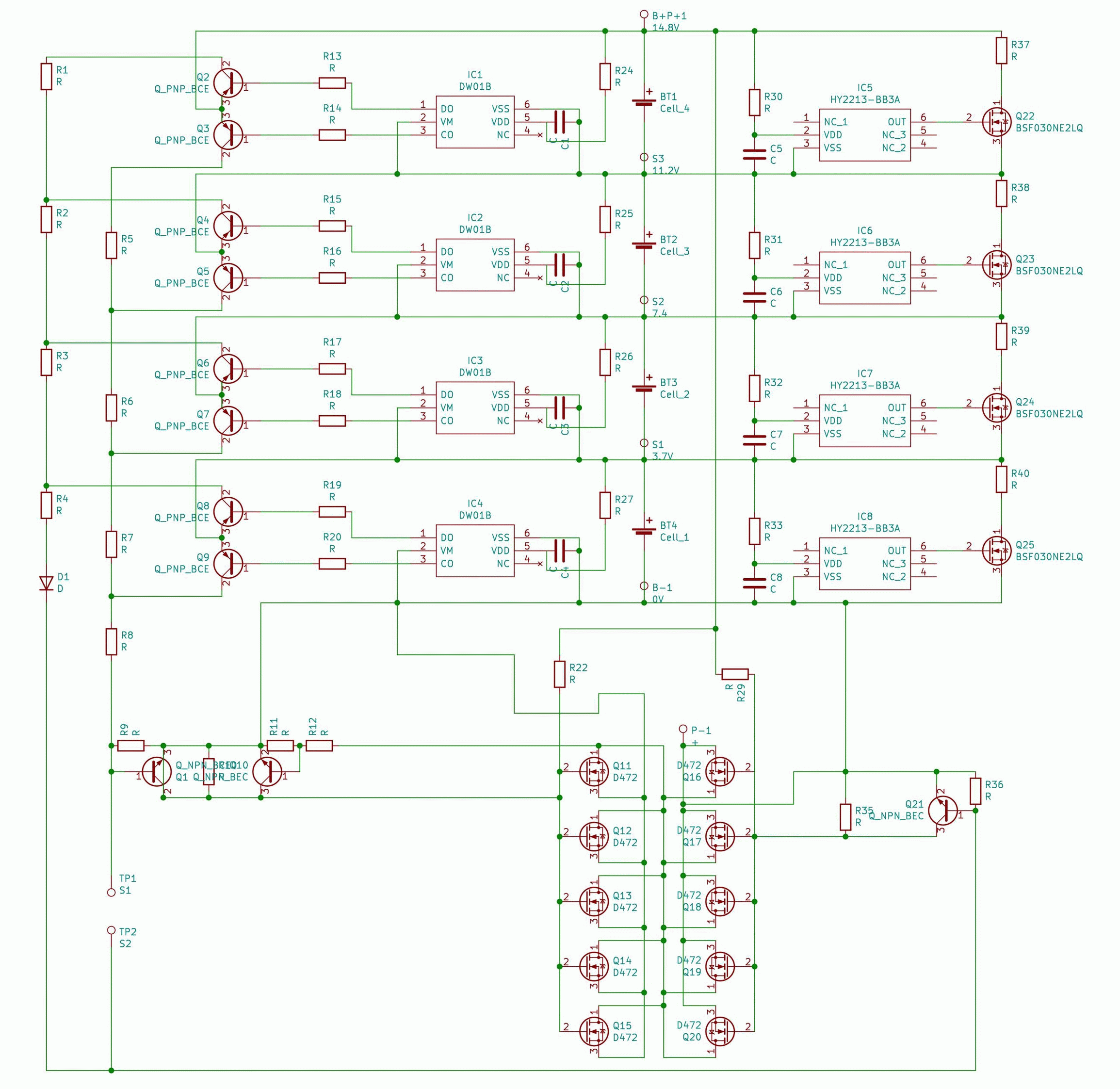
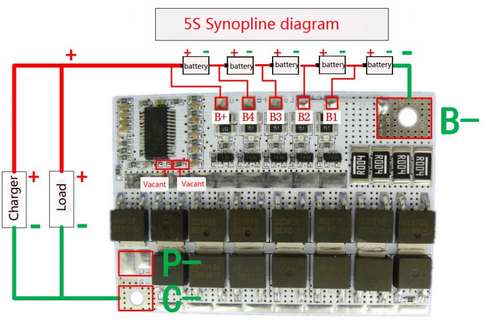
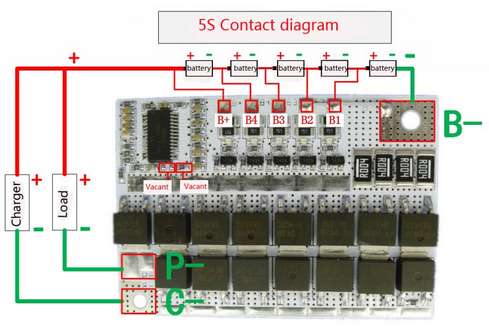
- https://techfun.sk/produkt/bms-modul-pre-litiove-baterie-3s-4s-5s-100a/
- https://www.laskakit.cz/ochrana-li-ion-baterie-5s-100a-2/
- Max balancing curent is 60mA
- Youtube - how to balance battery pack
LDO Regulators
- HT7333 - 3.3V LDO regulator - 12V input, 250mA max, 4uA quiescent ... https://www.holtek.com/documents/10179/148997/guide.pdf
ORDERED BY Vdrop :
| Part | Vin | Imax | Iq | Vdrop | Note |
| MAX1724 | 0.91 - 5.5 V | 1.5 uA | - | Step up, Indutor de 10 µH | |
| ISL91107IR | 1.8 - 5.5 V | 2000 mA | 45 uA | - | Buck-Boost 96% efficiency |
| AAT1217 | 6 V | 600 mA | 300 - 500 uA | - | stepup 93% efficiency |
| MCP1700 | 6 V Max | 250 mA | 1.6 uA | 78 mV | |
| HT7133 | 24 V | 30 mA | 4.0 uA | 100 mV | @1mA |
| HT7333 | 12 V | 250 mA | 3.5 uA | 90 mV | @Iout=40mA, NO SoftStart |
| HT7333-1 | 30 V | 250 mA | 2.5 uA | 120 - 300 mV | @Iout=30mA, SoftStart |
| HT7333-2 | 30 V | 250 mA | 2.5 uA | 120 - 300 mV | @Iout=30mA, SoftStart |
| HT7333-3 | 30 V | 250 mA | 1.0 uA | 120 - 300 mV | @Iout=30mA, SoftStart |
| TPS73633 | 5.5 V | 400 mA | 10 mA??? | 75 - 200 mV | |
| MCP1825 | 6 V Max | 500 mA | 120 - 220 uA | 210 - 350 mV | |
| AP2112 | 6 V Max | 600 mA | 55 uA | 250 mV | |
| RT9013 | 5.5 V Max | 500 mA | 25 uA | 250 mV | |
| TLV73333 | 5.5 V Max | 300 mA | 34 uA | 150 mV | |
| XC6203(XC6203E33) | 8 V Max | 400 mA | 8 uA | 300 mV | |
| HT7833 | 8 V Max | 500 mA | 4 uA | 360 - 500 mV | @Iout=500mA |
| LM2936 | 5.5 - 40 V | 250 mA | 20 uA | 400 mV | |
| SPX3819 | 16 V Max | 500 mA | 8 uA | 550 mV | |
| TC1262 | 6 V | 500 mA | 130 uA | 650 mV | |
| AMS1117 | 12 V Max | 1000 mA | 5 mA | 1300 mV | @Iout=800mA |
Boosting Output current
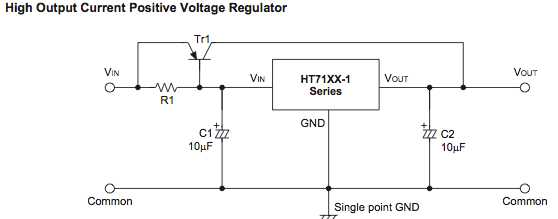
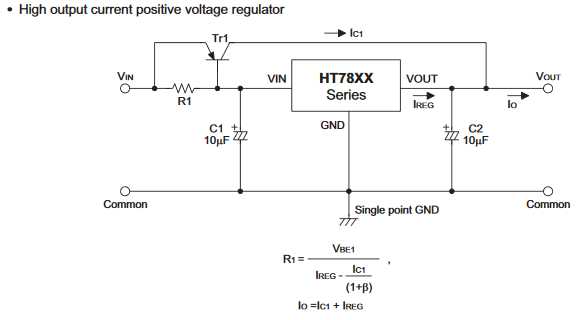

- https://electronics.stackexchange.com/questions/180191/increase-ldo-current-with-pnp
- The input voltage will need to exceed the output by the Vbe of the transistor + VCE(sat) + V(dropout)[LDO].
Under most conditions, that is about 1V plus the LDO dropout voltage.
If you can live with the added V(in), then the outboard boost will operate. - The boost circuit will turn on at about 0.6V/R1. If you wanted to engage the boost at 30mA, then the resistor is 0.6/0.03 = 20 ohms. That 30 mA will (mostly) still pass through the regulator. The mostly refers to the fact that the transistor base current must be supplied from the input, so the output provided from the LDO is 30mA - Ib. All other current is being supplied from the outboard boost transistor.
- for HT7133 R1 = 0.6V / 30mA = 20 Ohm; Vin = 3.3V + 0.6V + 100mV = 4.0V
- for HT7333 R1 = 0.6V / 250mA = 2.4 Ohm; Vin = 3.3V + 0.6V + 90mV = 3.99V
- for HT7833 R1 = 0.6V / 500mA = 1.2 Ohm; Vin = 3.3V + 0.6V + 400mV = 4.3V
- The input voltage will need to exceed the output by the Vbe of the transistor + VCE(sat) + V(dropout)[LDO].